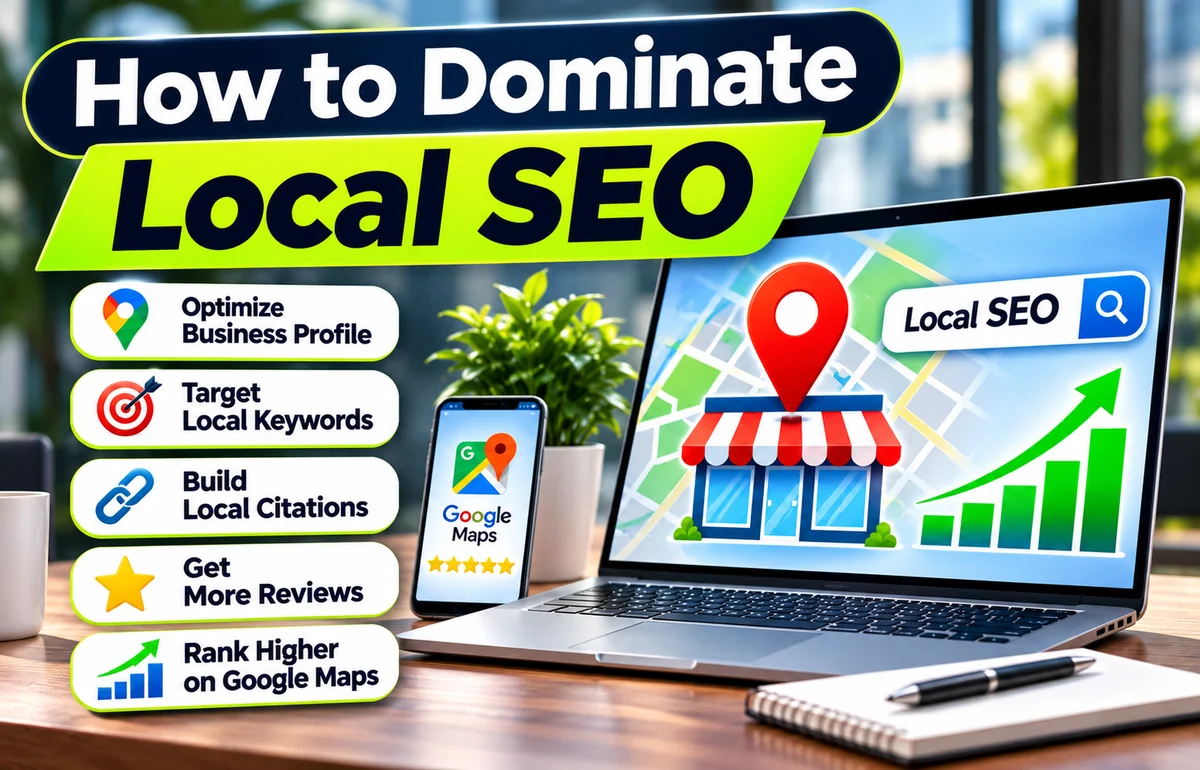
Introduction & The Core Reality of Local SEO
What Does It Actually Mean to “Dominate” Local SEO?
Dominating local search means capturing the top spots in the Google Local Map Pack and organic results across your entire service area, rather than just directly outside your physical address. It relies on aligning your digital presence with how search engines evaluate geographic relevance and business authority.
Many business owners believe they are permanently stuck ranking only in their immediate neighborhood. In reality, a structured website architecture and optimized profile configuration allow traveling contractors and service-area businesses to reach customers across multiple surrounding towns.
The Core Pillars: Relevance, Distance, and Prominence Explained
Google relies on three primary evaluation signals when deciding which local businesses appear at the top of search results. Understanding these factors helps you focus your time and resources on tactics that actually drive phone calls and form submissions.
- Relevance: How closely your Google Business Profile and website match what a local user is searching for, determined by your categories, services, and content.
- Distance: How far your physical location or designated service area is from the person typing the search query or searching from a mobile device.
- Prominence: How well-known and trusted your business is offline and online, measured through reviews, citations, local backlinks, and web authority.
For example, a residential plumbing company serving a major metropolitan county cannot easily change its physical headquarters. However, by optimizing for relevance and building local prominence through targeted pages, that business can successfully rank for searches originating fifteen or twenty miles away.
The Proximity Barrier & How to Overcome It
The Proximity Problem: Why Service Businesses Get Trapped in Their Backyard
Physical address proximity remains a heavy ranking constraint because search engines naturally favor businesses located closest to the user. For service-area businesses and traveling contractors, this creates a frustrating limitation where visibility drops sharply outside a tiny radius, trapping companies in their immediate neighborhood and cutting off wider regional lead generation.
This challenge is commonly known as the backyard trap. It severely limits local visibility by penalizing businesses that travel to clients instead of hosting them on-site.
- Single-Address Plumber: Relies entirely on a home office address, causing map rankings to vanish just a few miles away in neighboring commercial districts.
- Multi-City Localized Contractor: Uses structured location pages and targeted signals to establish genuine geographic reach across multiple nearby towns without needing a physical office in each.
Shifting from Address Dependency to Multi-City Expansion
Bypassing strict distance limits requires shifting your digital strategy away from sole reliance on your physical address toward dedicated multi-city service architecture. By building tailored landing pages and aligning your profile signals, you establish legitimate relevance across all your targeted operating zones.
To break free from geographic limitations successfully, implement a systematic expansion framework:
- Map out a realistic service radius based on your actual travel capabilities rather than targeting distant markets you cannot service.
- Develop unique, high-value landing pages for each specific city and service combination you want to capture in search results.
- Update your digital profile listings to connect core product categories directly to your newly created regional pages.
Step-by-Step Blueprint for Building Scalable Service-Location Pages
Step 1: Inventory Your Core Services and Target Cities
Building scalable localized landing pages starts by mapping your core service offerings against your actual operating zones in a clean keyword matrix. This structured approach prevents keyword cannibalization and ensures every unique page targets a distinct municipal audience without overlapping content.
Creating this matrix gives you a clear structural overview before writing any copy or setting up URLs. Review the table below for a practical example of how to combine core services with specific target cities.
Step 2: Prioritizing Pages by Search Volume and Business Impact
Prioritize your page creation queue by evaluating search volume and commercial intent using keyword research tools like Google Keyword Planner or Semrush. Launching high-impact service and city combinations first ensures your limited time and marketing budget generate immediate client calls.
When organizing your rollout schedule, keep these prioritization guidelines in mind:
- Target your highest-revenue services in your largest neighboring cities during the initial phase.
- Verify that monthly search volume exists for the specific combination before spending hours writing content.
- Ensure your field team can physically service the geographic area within a reasonable response time.
Step 3: Designing High-Converting Service-Location Pages
Treat every service-location page like a primary landing page rather than a thin, duplicated blog post. Modeling these pages after your homepage layout keeps visitor engagement high, builds trust instantly, and provides the rich conversion elements searchers expect.
Avoiding generic cookie-cutter templates protects your crawl budget and prevents search engines from dismissing your pages as low-quality doorway content. Make each page genuinely useful by incorporating these elements:
- A prominent primary headline featuring the exact service and city combination.
- Clear local context, including neighborhood references, local landmarks, or regional service details.
- Trust signals such as customer reviews, transparent pricing indicators, and straightforward contact forms.
Optimizing Your Google Business Profile (GBP) for Multi-City Dominance
Locking Down Primary & Secondary Categories Without Keyword Stuffing
Selecting the right primary category and filling out targeted secondary categories is critical for local visibility. However, adding extra keywords into your business name violates terms of service and triggers immediate profile suspensions. Clean, honest categorization builds long-term trust and protects your listing from algorithmic penalties.
Audits routinely catch businesses attempting to manipulate map rankings by stuffing terms into their business name. To stay fully compliant and avoid losing your listing, review Google’s official Business Profile guidelines before updating your profile details.
- Choose a primary category that precisely mirrors your core business activity.
- Add secondary categories that cover your most important related services.
- Keep your business name identical to your official registration documents without added city names or keywords.
Connecting GBP Product Listings to Your Service-Location Pages
You can bridge your physical profile to your multi-city landing pages by utilizing the product and service inventory feature inside your dashboard. Linking individual service items directly to their corresponding regional web pages passes crucial context and drives direct user traffic.
Execute this connection methodically within your dashboard by following these steps:
- Log into your Google Business Profile account and select your active business location.
- Navigate to the Products or Services tab and click to add a new entry.
- Enter your service and city combination as the product title.
- Insert the exact URL of your dedicated service-location page into the optional link field.
- Save your entries to link your map profile directly to your multi-city architecture.
Configuring Service Area Settings Correctly
Service-area businesses must define their operational boundaries by listing the specific cities and neighborhoods they travel to. While this geographic setting does not directly boost map rankings, it ensures prospective customers understand your true coverage zone.
Keep your service area setup clean and realistic by following these best practices:
- Add targeted municipalities one by one based on your actual travel capabilities.
- Ensure your business name, address, and phone number maintain absolute NAP consistency across all external listings.
- Avoid setting an unrealistically large radius that triggers automated quality filters.
Off-Page Signals, Local Citations, and Authority Building
Building High-Impact Local and Industry Citations
Local citations are online mentions of your business name, address, and phone number (NAP) across the web. Building them requires a measured, deliberate approach rather than automated spamming, because flooding low-quality aggregators with rapid submissions can look unnatural and harm your rankings.
Citation velocity—the speed at which your business acquires new listings—plays a key role in how search engines evaluate authority. To build trusted signals safely, prioritize directory submissions using a structured rollout plan:
- Claim profiles on major general platforms like Yelp and YellowPages to establish baseline credibility.
- Target hyper-local municipal platforms, such as your local chamber of commerce or regional business boards.
- Secure niche-specific trade directories tailored directly to your specific industry rather than generic web listings.
- Maintain strict NAP consistency across every single directory to prevent confusing search engine crawlers.
Earning Local Backlinks That Move the Needle
Earning local inbound backlinks requires active community involvement, strategic outreach, and targeted digital PR campaigns. Securing links from regional websites and community partners signals strong geographical prominence to search engines, helping your service-location pages rank above local competitors.
Moving the needle with off-page link building involves practical execution methods that provide genuine community value:
- Partner with local charities, school events, or community sponsorships to earn authoritative regional links.
- Pitch local news outlets or regional blogs with expert commentary on home improvement or service trends.
- Contribute high-value guest articles to complementary trade blogs while linking naturally back to your core content.
- Analyze competitor backlink profiles to identify regional link opportunities you can replicate ethically.
Overcoming Common Local SEO Pitfalls & Community Objections
Addressing the “Stagnant Map Pack” Syndrome
When map rankings plateau despite having location pages, it usually points to a lack of review velocity, missing local signals, or unmonitored grid rank drops. Diagnosing these bottlenecks requires tracking your actual map visibility across different neighborhood zip codes rather than relying on a single central check.
Business owners often complain on community forums, saying, “I built location pages and nothing happened!” The missing link in these situations is almost always active review generation and proper localized schema markup. Without fresh reviews mentioning specific services and clear structured data, search engines cannot verify your local authority.
- Use local rank tracking software to map your visibility across surrounding zip codes and identify exact drop-off points.
- Establish a consistent text and email follow-up system to steadily increase your monthly review velocity.
- Deploy Local Business schema markup on your service pages to explicitly declare your operational zones to search crawlers.
Avoiding the Thin Content & Duplicate Page Trap
Creating multiple service-location pages can trigger search penalties if the text is just a copy-pasted template with swapped-out city names. Avoiding this thin content trap requires customizing each page with genuine local value, distinct community details, and responsible AI content customization.
Treating every page as a unique asset protects your site from quality filters and ensures higher visitor engagement. Implement these safeguards when generating regional content:
- Incorporate specific local landmarks, regional service challenges, and neighborhood names into your copy.
- Ensure body paragraphs, FAQs, and client feedback sections differ significantly across every regional landing page.
- Review each page manually to guarantee it reads naturally and provides real answers to prospective local clients.
Frequently Answered Questions (PAA & Search Intent Capture)
What is the single most important ranking factor for local SEO?
The single most important ranking factor for local SEO is the optimization and authority of your Google Business Profile, heavily driven by proximity and category relevance. Local ranking algorithms evaluate how closely your profile matches user intent and whether your business is trusted within the community.
While website optimization and local backlinks provide crucial supporting strength, your map profile acts as the primary gateway for local search visibility. Focus your initial efforts on locking down accurate categories and building consistent review signals before tackling advanced off-page campaigns.
How many service-location pages should my startup create?
Startups should create service-location pages gradually, starting with their top three core services across their three highest-priority surrounding cities before expanding further. Launching too many pages at once without adequate local context can trigger automated quality filters.
Scale your regional page count responsibly by following these core guidelines:
- Focus exclusively on towns where your team can realistically travel to service clients within a reasonable timeframe.
- Prioritize high-intent keyword combinations that demonstrate measurable search volume in keyword research tools.
- Ensure every new page features distinct regional details rather than repetitive, copy-pasted templates.
Can service-area businesses rank without a physical storefront in every city?
Yes, service-area businesses can successfully rank across multiple cities without a physical storefront by building targeted landing page architecture and optimizing their profile service areas. When comparing a traditional storefront vs SAB setups, search algorithms rely heavily on website signals and regional relevance rather than physical foot traffic.
You bridge this physical gap and earn visibility in neighboring markets by implementing specific strategies:
- Creating dedicated, high-value landing pages tailored to each targeted municipality.
- Linking your Google Business Profile product listings directly to those regional web pages.
- Earning local citations and regional backlinks that prove your geographic authority.
How do I fix a suspended Google Business Profile?
Fixing a GBP suspension requires reviewing compliance guidelines, correcting policy violations like name stuffing, and submitting a formal reinstatement request with official documentation. Handling a sudden GBP suspension successfully depends on addressing address discrepancies and providing verifiable proof of operation.
Resolve listing penalties systematically by completing these verification steps:
- Remove any unauthorized keywords, service terms, or city names from your official business title.
- Verify that your listed address matches your state registration documents, utility bills, and signage.
- Gather official business licenses, tax documents, and storefront photos before filing your reinstatement appeal.
Key Takeaways & Strategic Next Steps
Your Local SEO Domination Action Checklist
Achieving lasting results with a local SEO roadmap requires patience, steady execution, and disciplined tracking rather than reliance on overnight hacks. Sticking to a structured weekly rollout allows small business owners and startup founders to build sustainable geographic prominence step by step.
Organize your execution timeline into clear, manageable phases to maintain steady momentum without overwhelming your team:
- Week 1: Audit your Google Business Profile, lock down correct primary and secondary categories, and clean up NAP consistency across existing directories.
- Week 2: Build out your core service and target city matrix, prioritizing high-intent search volumes and realistic travel radiuses.
- Week 3: Design unique, high-converting service-location landing pages modeled after your homepage layout, ensuring rich local context and schema markup.
- Week 4: Launch a consistent review generation workflow and establish trusted local citations and regional backlink campaigns to fuel prominence.
Ready to Scale Your Local Presence?
Executing a multi-city local search strategy while managing daily business operations can stretch your internal resources thin. When you are ready to delegate technical optimizations and focus entirely on servicing new clients, professional support can streamline your regional growth.
To discover how we can help you capture high-intent regional traffic, feel free to explore our comprehensive local SEO services tailored specifically for US small businesses, analyze regional footprints across our targeted location service strategies, or return to explore our core professional local SEO solutions for sustainable growth.