The Hard Truth About the Local SEO Timeline
Local SEO is not an overnight switch that floods your business with phone calls immediately. Building real local trust, establishing geographic relevance, and earning top positions in Google search results typically requires a consistent six-month effort for US small businesses and startups.
Why 6 Months is the Real Turning Point for Local SEO
Search engines take time to crawl, verify, and trust your business details against competitors in your local market. When you launch or optimize your digital presence, algorithms must evaluate your website structure, Google Business Profile signals, and customer review velocity. This algorithmic trust builds gradually, which is why meaningful ranking shifts and steady map pack movements generally surface between three and six months of disciplined optimization.
- Google needs time to crawl your updated service pages and map out your local keywords.
- Competitors in your service area have a head start that requires consistent signals to overcome.
- Customer review consistency and local citation updates compound in value over several weeks.
Impressions vs. Leads: What Actually Matters in the First 6 Months
Business owners often panic during the first two months because search visibility starts rising, but the phone is not ringing constantly yet. Understanding the difference between vanity metrics and revenue-driving indicators helps prevent premature frustration.
- Search Impressions: The number of times your business appears in search results or map views. This always spikes weeks before actual clicks happen.
- Website Clicks: Visitors landing on your site to read your service pages or check your contact information.
- Map Pack Visibility: Your appearance in the top three local map listings for target neighborhood queries.
- Actual Phone Calls & Leads: The ultimate revenue-driving metric that typically accelerates around months four through six as local authority solidifies.
For instance, a plumbing contractor serving three nearby suburbs might see thousands of impressions in month two, but very few inbound calls until month four when their service-area pages achieve stable top-five map rankings. Panic often sets in around month two when impressions climb but calls lag behind, even though this exact pattern is completely normal for any competitive local service market.
If you want to understand how a structured approach fits your business model, look at how professional Local SEO Services build a sustainable foundation from day one.
Month 1: Setting the Foundation and Baseline Audit
The first thirty days of local optimization are entirely about fixing technical roadblocks and establishing clear tracking so you can accurately measure future growth. Skipping these foundational steps in month one creates structural barriers that can easily delay your results past month six.
Auditing Your Current Digital Footprint
Recording your exact starting metrics before making changes allows you to track real progress instead of guessing whether your strategy is working. Without a clear baseline audit, you will never know which adjustments moved your local rankings forward.
- Export current impressions, clicks, and average ranking positions from Google Search Console.
- Document your current Google Map Pack rankings for your top five core revenue-generating services.
- Audit existing local citations across major directories to spot incorrect addresses or old phone numbers.
Claiming and Optimizing Your Google Business Profile (GBP)
Your Google Business Profile is the absolute anchor of your local visibility and map pack performance. Optimizing this asset correctly during your first month establishes immediate relevance for local searchers.
- Claim and verify your business profile, ensuring your primary category matches your core service precisely.
- Verify that your Name, Address, and Phone number (NAP consistency) match your website footer and official documents word-for-word.
- Define your exact service-area boundaries or list accurate storefront operating hours if customers visit your location.
Technical Cleanup and Local Keyword Mapping
Fixing technical website errors ensures search engine bots can crawl and index your pages without wasting valuable crawl budget. Proper keyword mapping pairs your core services with the exact terms local customers use.
- Resolve broken links, fix indexation errors, and ensure mobile loading speeds meet modern standards.
- Map high-intent local keywords directly to dedicated service pages rather than cramming everything onto the homepage.
- Implement clean URL structures that include your target location and core service identifier.
Before moving forward, ensure your core setup is thoroughly evaluated through a comprehensive Local SEO Services framework designed specifically for US markets.
Months 2 to 3: Early Signals, Indexing, and Long-Tail Traction
Months two and three mark the critical quiet period where search engines process your foundational changes and begin crawling newly published assets. Understanding how algorithms evaluate your site during this phase prevents premature panic and keeps your growth strategy on track.
What to Expect in Months 2–3 (Impressions vs. Clicks)
During months two and three, you will often notice a steady climb in search impressions long before actual clicks or phone calls begin to roll in. This happens because search engines are actively testing your pages for long-tail local terms across a wider geographic radius, but user trust and top-tier rankings take slightly longer to solidify.
- Search engines begin indexing your newly published content and recognizing your geographic footprint.
- Impressions rise as your business appears in broader search queries and expanded map views.
- Direct website clicks and inbound phone inquiries remain modest while algorithmic trust builds.
Publishing Core Service Pages and Local Schema
Deploying structured data and targeted service pages provides search engine crawlers with explicit context about your offerings and service locations. This technical layer bridges the gap between raw code and local search visibility.
- Implement `LocalBusiness` schema across your main pages to clearly communicate your business identity and hours.
- Add `Service` and `areaServed` markup to help search algorithms match your offerings with nearby customer searches.
- Publish distinct, highly specific service pages for each core offering rather than relying on a single generalized page.
Citation Cleanup and Review Generation Momentum
Building a consistent digital footprint across directories while steadily gathering customer reviews creates powerful signals of real-world legitimacy. This phase requires active participation from your team and customers to build genuine momentum.
- Clean up inconsistent business listings across major directories to ensure absolute NAP accuracy.
- Establish an automated or systematic process to request reviews from satisfied customers immediately after service completion.
- Respond professionally to all new reviews to demonstrate active engagement to both potential clients and search algorithms.
Many business owners make the mistake of firing their SEO agency around month two because they do not see massive sales pouring in yet. Online community discussions on Reddit and Quora frequently highlight this exact friction point, where founders panic during the quiet period right before indexing signals turn into tangible traffic. Recognizing that early indexing is an algorithmic sorting phase helps you stay patient while the foundation matures into real lead generation.
Months 4 to 6: Traction, Map Pack Movement, and Lead Growth
By months four through six, your early technical adjustments, structured data, and review momentum begin to compound into visible commercial growth. This is the stage where local businesses typically transition from tracking subtle impressions to experiencing predictable map pack visibility and consistent phone inquiries.
Unlocking the Google Map Pack (Local 3-Pack)
Achieving visibility in the coveted local 3-pack depends on the powerful convergence of review velocity, proximity signals, and profile optimization. As search engines verify your business legitimacy over several months, your maps ranking naturally climbs for high-intent commercial terms.
- Consistent customer review acquisition strengthens your profile’s relevance and trustworthiness in local searches.
- Optimized proximity and category signals help your listing surface for users searching from nearby neighborhoods.
- Active engagement and accurate data updates keep your map placement stable against competing local businesses.
Expanding via Service-Area Pages and Local Content
Scaling your reach into neighboring towns requires intentional content architecture that targets specific geographic keywords without causing keyword cannibalization on your main site. Creating distinct, helpful pages for each service area gives search engines clear entry points for regional searchers.
- Publish dedicated service-area pages tailored to the unique neighborhoods or suburbs you serve.
- Address common customer questions specific to regional regulations, climate needs, or local service challenges.
- Ensure each page features unique content rather than copying and pasting the same text across multiple city templates.
Earning Local Backlinks and Digital PR
Building local authority requires earning genuine mentions and links from other businesses, community organizations, and regional publications within your operating area. White-hat digital PR strategies focus on building real community ties rather than spamming low-quality directory networks.
- Partner with local suppliers, industry associations, or community charities to sponsor local events or initiatives.
- Contribute expert commentary or helpful tips to regional news outlets covering local business trends.
- Monitor local competitor link profiles to identify natural community partnership opportunities in your service region.
Consider a practical scenario of a residential HVAC contractor operating across a major metropolitan region. In month one, their listing sat buried on page three of local search results with virtually no map visibility. By month four, following systematic review generation and local citation cleanup, their Google Business Profile climbed into the lower map positions. By month six, after publishing targeted service-area pages for neighboring suburbs, their listing secured a top-three map pack position, resulting in a steady, predictable flow of inbound service calls.
if you operate across multiple cities or distinct neighborhoods, implementing targeted Locations Optimization ensures you capture localized intent efficiently.
Factors That Accelerate or Slow Down Your 6-Month Timeline
Two different businesses operating in the exact same city can experience vastly different growth speeds during their local SEO campaigns. Market density, domain background, and resource allocation dictate whether your milestones happen closer to month three or stretch past month six.
Market Competition and Niche Density
The level of competition in your specific industry and geographic market is one of the biggest drivers of your SEO timeline. High-stakes or densely populated commercial sectors require significantly more authority and trust signals to outrank established incumbents.
- High-competition niches like personal injury law, cosmetic dentistry, or emergency restoration require extensive authority building and deeper content depth.
- Lower-competition local trades or specialized service providers in smaller markets often experience faster map pack movement due to lower baseline competition.
- Metropolitan markets with hundreds of competing businesses require sustained optimization to break into the top three local positions.
Domain Age, History, and Existing Trust
The starting point of your website fundamentally changes how quickly search engine algorithms respond to your optimization efforts. Launching on a brand-new domain requires building trust from scratch, whereas an established site with historical authority moves much faster.
- Brand-new, unindexed domains must go through an initial discovery and sandbox phase where search engines cautiously verify legitimacy.
- Established websites with a clean backlink history and historical indexing capitalize on technical updates much quicker.
- Past penalties or poor technical optimization can severely stall your timeline until historical errors are fully resolved.
Execution Speed and Resource Allocation
SEO results scale directly with the consistency and quality of your execution. A low budget or sporadic publishing schedule naturally slows down algorithmic trust, while a robust, well-funded strategy accelerates milestone achievement.
- Consistent weekly content publishing and rapid review acquisition signal continuous business activity to search crawlers.
- Underfunded campaigns with delayed citation cleanup and infrequent updates often drag the timeline out well past the standard six-month window.
- Proactive technical maintenance prevents unexpected indexing drops that can derail months of steady progress.
For more insights on navigating algorithm updates and search requirements, review the Search Engine Land Local SEO Guide for industry benchmarks.
Frequently Asked Questions About the Local SEO Timeline
Business owners navigating local search optimization often run into the same recurring questions, frustrations, and doubts on community forums like Reddit and Quora. Addressing these real-world concerns with honesty helps clear up common misconceptions and protects you from misleading agency promises.
Why am I getting impressions on Search Console but zero phone calls at Month 3?
Search console impressions always arrive weeks or months before actual phone calls because search engines must first test your visibility across various long-term queries before awarding you top-tier placement. At month three, your site is appearing in broader searches, but until your ranking solidifies in the top three map positions or top organic spots, local customers rarely scroll down far enough to convert.
- Impressions indicate that your technical foundation and keyword mapping are working as intended.
- Low click-through rates usually mean your meta descriptions, review counts, or map rankings still need improvement.
- Inbound calls naturally lag behind impressions because buyers typically choose businesses sitting at the very top of local results.
Can I speed up local SEO results by spending more on ads?
Pumping money into paid search ads can generate immediate phone calls, but it does not accelerate your organic local SEO timeline or build permanent algorithmic trust. Paid advertising and organic optimization operate on separate tracks, meaning stopping your ad spend will immediately cut off your lead flow, whereas organic rankings compound in value over time.
- Paid ads capture high-intent buyers instantly while your organic rankings mature in the background.
- Search engine algorithms do not reward ad spend with higher organic rankings or faster indexation.
- A balanced strategy combines paid search for immediate cash flow with local SEO for long-term, cost-effective lead generation.
What should I do if my rankings drop unexpectedly during Month 4 or 5?
An unexpected drop in rankings halfway through your campaign can be alarming, but it is usually caused by a technical glitch, a minor Google algorithm update, or a disruption in your Google Business Profile. Panicking and rewriting your entire website can actually make the fluctuation worse, so a systematic troubleshooting approach is essential.
- Check Google Search Console immediately to see if manual penalties or widespread indexing errors occurred.
- Verify that your Google Business Profile has not been suspended, unverified, or hit with accidental data changes.
- Confirm your Name, Address, and Phone number remain 100 percent consistent across your site and major directory listings.
Any agency promising a guaranteed number-one ranking in thirty days is relying on outdated tactics or deceptive marketing. Sustainable local visibility takes patience, structural integrity, and consistent execution. If you are trying to figure out what kind of investment makes sense for your growth stage, review our transparent SEO Pricing Models to see what fits your business.
Conclusion and Next Steps for Your Business
Achieving sustainable growth in your local market requires a blend of technical discipline, patience, and consistent execution over time. By focusing on steady milestones rather than falling for quick-fix promises, you build a resilient digital presence that generates predictable leads year after year.
Summary of Your 6-Month Local SEO Journey
Navigating the local SEO roadmap effectively means understanding what each phase demands of your business. Reviewing this structured progression helps keep your strategy aligned with how search engines evaluate local authority.
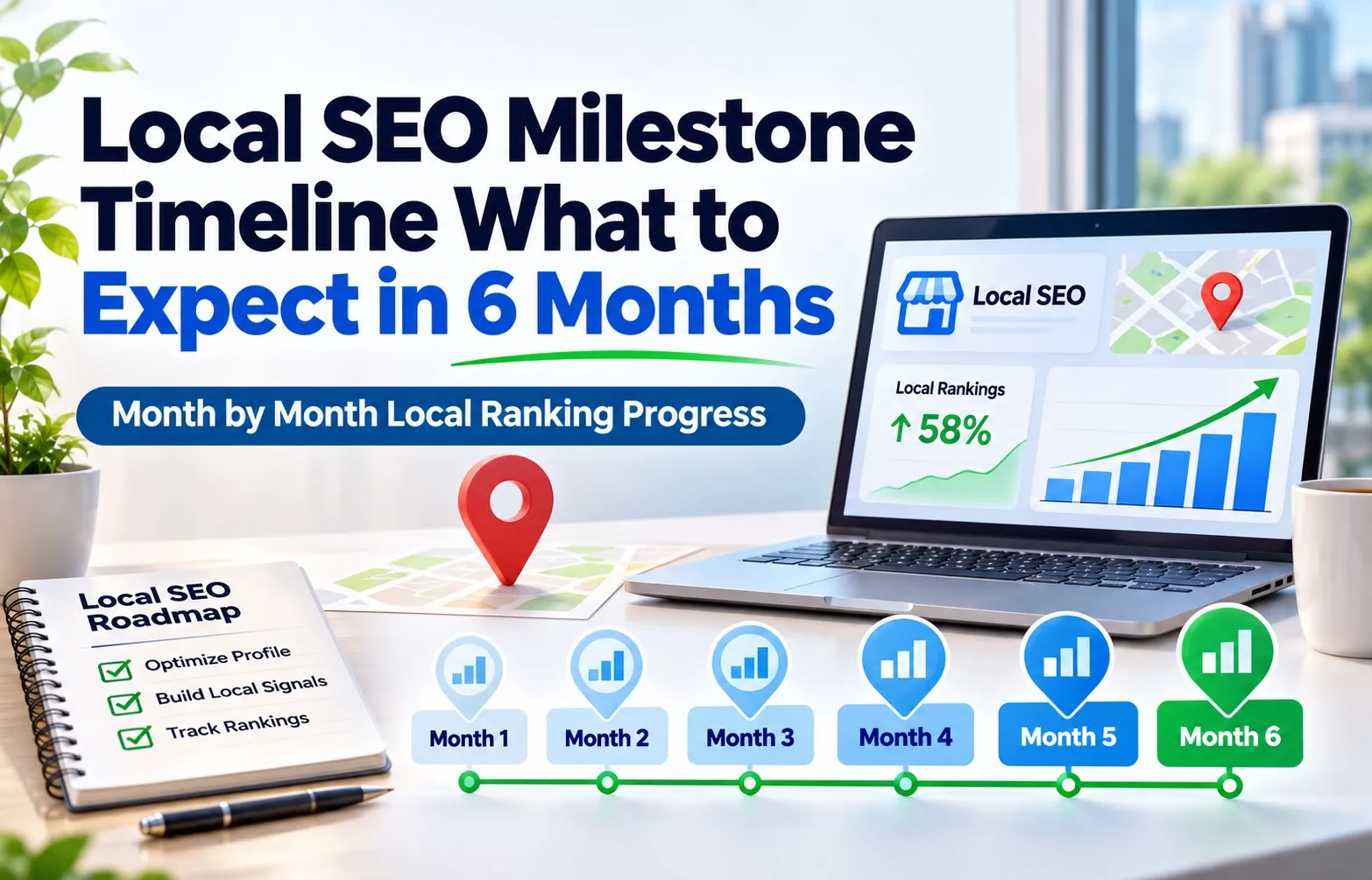
- Month 1: Establish your baseline metrics, claim and optimize your Google Business Profile, and resolve technical errors.
- Months 2 to 3: Publish targeted service-area pages, deploy local schema markup, and build steady customer review momentum while impressions begin to climb.
- Months 4 to 6: Unlock the Google Map Pack, expand local content reach, and convert growing search visibility into reliable phone calls and revenue.
Taking the Next Step in Your Local Market
Transforming your digital footprint into a reliable asset starts with evaluating where you stand today against your local competitors. Taking a systematic approach to your strategy ensures your marketing efforts deliver maximum long-term return on investment without wasted spending.
- Audit your current Google Business Profile and website technical health to identify immediate roadblocks.
- Commit to a consistent process for gathering customer reviews and publishing helpful local content.
- Evaluate whether managing your digital marketing strategy internally or partnering with an expert makes sense for your growth stage.
ready to map out a custom 6-month growth plan for your business? Explore our professional Local SEO Services to get started.