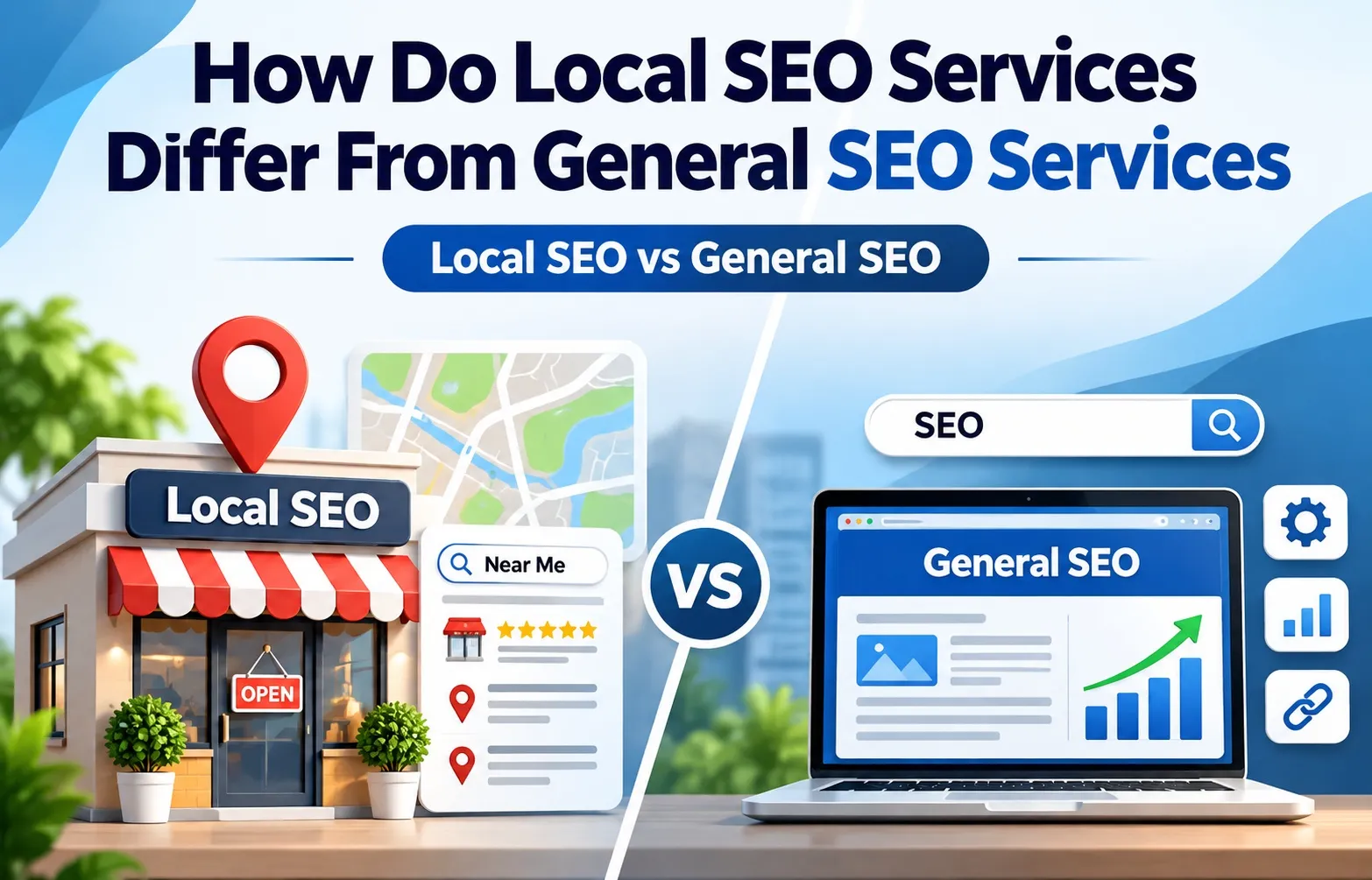
The Core Difference at a Glance
What is the Fundamental Difference Between Local and General SEO?
General search engine optimization focuses on broad, national, or global visibility to build long-term domain authority. Local search engine optimization hurls focus directly at geographical proximity, explicit local intent, near me searches, and local map pack visibility.
Understanding this distinction prevents small business owners from wasting marketing budgets on strategies built for global ecommerce brands. If customers visit a physical storefront or book home services within a specific city, traditional national tactics fail to drive phone calls or foot traffic.
Quick Comparison
Many local business owners hire national digital marketing agencies without realizing that general search campaigns ignore geographic targeting. Reviewing these common pitfalls helps clarify resource allocation:
- Targeting broad terms like HVAC repair instead of city-specific phrases like HVAC contractor in Austin.
- Building backlinks from unrelated international blogs instead of acquiring citations from local chambers of commerce.
- Ignoring map listings entirely while pouring resources into national blog content that fails to convert local searchers.
Defining General SEO (National & Broad-Scale)
Who is General SEO Built For?
General search engine optimization is designed for brands that operate without geographic boundaries, such as national e-commerce stores, cloud-based software companies, and digital publishers. These businesses need to capture broad audiences across entire countries or global markets rather than targeting specific neighborhoods or cities.
Understanding who traditional search optimization serves helps prevent costly misallocations of marketing capital. Local service providers often mistake high national search volumes for business opportunities, leading them to target broad queries that fail to convert into local phone calls or store visits.
- National E-Commerce Stores: Retailers shipping products nationwide that compete on price, product variety, and brand authority.
- Cloud-Based Software (SaaS): Companies offering digital tools accessible from anywhere, requiring broad top-of-funnel educational traffic.
- Digital Publishers: News sites, blogs, and media networks monetizing massive volumes of non-location-specific traffic through ads or subscriptions.
- Multi-State Enterprises: Large franchises or corporate entities managing centralized brand campaigns across multiple regions.
Core Pillars of Traditional SEO
Traditional search engine optimization relies heavily on massive domain authority, high-level backlink acquisition from major industry publications, broad keyword targeting, and exhaustive long-form content depth. Success requires competing against established giants across entire national indexes.
Attempting to rank nationally for a local service term drains marketing budgets because the competitive landscape demands immense financial and technical resources. For example, a single-location home remodeling contractor trying to rank nationwide for kitchen design guides will compete against home improvement conglomerates with multi-million dollar content budgets instead of capturing local homeowners ready to hire.
- High-Level Backlink Acquisition: Securing editorial links from high-authority news outlets, industry journals, and prominent digital publications to build cumulative domain trust.
- Broad Keyword Targeting: Optimizing for non-location-specific keywords that capture massive search volume but carry lower immediate commercial intent for local brick-and-mortar operations.
- Long-Form Content Depth: Publishing exhaustive guides, research pieces, and whitepapers designed to satisfy broad informational queries at a national scale over many months or years.
Defining Local SEO Services (Proximity & Map Domination)
What Makes Local SEO Unique?
Local search optimization is unique because it relies heavily on geographic proximity, user location signals, and explicit city-level keywords rather than pure domain authority. While national campaigns target broad interests, local campaigns capture ready-to-buy consumers searching for services right in their immediate neighborhood.
This hyper-localized approach changes how search engines evaluate relevance. Instead of competing against thousands of websites nationwide, your business only competes against local rivals operating within your specific service radius.
- Geographic Proximity: Search engines evaluate how close a business location is to the person searching to deliver immediate local options.
- Explicit City Modifiers: Users actively type geo-specific keywords like emergency plumber in Miami or air conditioning repair in Downtown Miami.
- Implicit Near Me Behavior: Mobile devices automatically share GPS coordinates, allowing search engines to serve relevant nearby businesses even without location words.
The Power of the Google Local Map Pack
Appearing in the top three positions of the Google Local Map Pack captures immediate phone calls and foot traffic before standard organic web results even appear on the screen. For local service providers, winning a spot in this map display is often the single most profitable driver of daily customer inquiries and booked appointments.
In practical observations from managing local service campaigns, a fully optimized Google Business Profile ranking in the top three map positions consistently generates far more high-intent emergency phone calls than a high-ranking national blog post. When a homeowner’s air conditioner breaks down in the middle of summer, they do not read a thousand-word national guide on cooling history; they tap the map pack and call the closest trusted local contractor.
- Instant Visibility: Map listings sit at the very top of mobile screens, outranking standard organic search results.
- Direct Conversion Actions: Users can tap to call your business, get driving directions, or visit your website instantly with a single touch.
- Trust and Reviews: Star ratings and verified client feedback displayed right in the map pack build immediate consumer confidence.
Key Structural Differences in Execution & Strategy
Keyword Strategy: Broad Volume vs. High-Intent Geo-Modifiers
National campaigns target high-volume, non-location-specific terms to build massive web traffic, while local search strategy relies heavily on high-intent geo-modifiers. Local keywords capture ready-to-buy customers who specify their exact city or neighborhood when searching for immediate solutions.
Comparing national terms like plumbing repair guide with local transactional terms like emergency plumber in Miami reveals a massive difference in conversion value. A national blog reader might live anywhere and want DIY advice, whereas a local searcher needs a professional at their door immediately.
- National Focus: Captures broad information seekers across wide geographic regions with lower immediate purchase intent.
- Local Focus: Targets high-intent consumers actively searching for services within a specific city or zip code.
- Conversion Value: Prioritizes phone calls, form fills, and booked appointments over raw organic page views.
Citations, Directory Management, and NAP Consistency
Local visibility requires rigorous directory management and strict name, address, and phone number consistency across platforms like Yelp, Apple Maps, and the Better Business Bureau. Unlike national campaigns that ignore directory listings, local search engines verify physical existence through these cross-references.
Following the Google Business Profile Guidelines helps ensure your business information remains uniform across the web. In practical fieldwork, a single mismatched suite number or old phone number across directories can confuse algorithms and break local map rankings entirely.
- Name Discrepancies: Using abbreviated business names on one directory and full legal names on another.
- Address Variations: Displaying an outdated phone number or former office address on secondary citation sites.
- Suite Mismatches: Inconsistent suite or unit numbers across local business directories and map profiles.
Review Management and Local Reputation Signals
Search engines utilize customer reviews as a fundamental ranking and trust factor for local map placements. While national brands rely on institutional backlinks, local businesses depend on steady streams of authentic consumer feedback and sentiment analysis to rank in competitive markets.
Review signals indicate active service quality and customer satisfaction directly to local algorithms. Businesses that actively manage their digital reputation through prompt responses and steady review acquisition consistently outperform stagnant competitors in the map pack.
- Review Volume & Frequency: Maintaining a consistent flow of fresh customer feedback over time rather than receiving reviews in isolated bursts.
- Keyword Sentiment: Natural mentions of specific local services within customer reviews that reinforce topical relevance.
- Owner Engagement: Professionally responding to both positive and negative reviews to demonstrate active business management.
Speed of Results and ROI: Which One Pays Off Faster?
Why Local SEO Wins on Speed and Conversion Efficiency
Local search optimization consistently yields faster returns on investment because local businesses compete against a handful of nearby rivals rather than thousands of global brands. Lower geographic competition combined with high-intent searchers enables local lead generation campaigns to generate phone calls and booked appointments much quicker.
For small business owners and startup founders operating under strict cash-flow constraints, waiting a year for marketing channels to produce revenue is rarely an option. Local strategies bypass lengthy authority-building phases by focusing directly on map visibility and immediate customer intent within a defined service radius.
- Reduced Competition Pool: Competing against businesses in a single city or neighborhood lowers the required SEO effort compared to a national stage.
- High-Intent Search Behavior: Local searchers usually need immediate service, resulting in a much higher conversion rate from click to phone call.
- Immediate Cash Flow Impact: Faster time-to-result helps smaller marketing budgets sustain themselves through generated client revenue.
The Long-Game Reality of General SEO
General search campaigns require a substantial six to twelve-month runway before accumulating enough domain authority to rank on a national level. National brands must consistently out-publish and out-link massive corporate competitors, making traditional SEO a slow capital investment for local service operations.
Pouring a small business marketing budget into broad national keywords often drains resources before any measurable return materializes. National optimization is built for brands with large capital reserves that can afford to wait out the long maturation timeline of high-level backlink acquisition.
- Extended Time-to-Result: Building national trust requires months of rigorous content creation and authority accumulation.
- Massive Capital Requirements: Competing against established national entities demands heavy ongoing spending on link building and content depth.
- Misaligned Cash Flow: Delayed financial returns create severe operational strain for local companies that rely on daily local leads.
Which Service Does Your Business Actually Need? (Decision Framework)
Checklist: Are You Local, National, or Hybrid?
Diagnosing your startup marketing strategy starts with mapping your exact operational footprint and customer delivery radius. Businesses that serve clients within specific physical cities require hyper-local optimization, whereas global software companies or national e-commerce retailers rely on broad digital visibility.
Conducting a proper business model evaluation prevents regional service operators from wasting thousands of dollars on bloated national marketing agencies that target irrelevant traffic.
- Local Service Area: Your revenue depends on customers within a specific driving distance, city, or neighborhood, such as local contractors, medical clinics, or home repair services.
- National or Global Reach: Your products or digital software are shipped or downloaded anywhere without geographic constraints, such as e-commerce stores or SaaS platforms.
- Hybrid Model: You maintain physical storefronts or service teams in multiple distinct cities, requiring separate location-based optimization for each regional market.
Scaling Your Brand with Professional Guidance
Bridging the gap between manual DIY efforts and professional execution accelerates growth by eliminating costly trial-and-error mistakes. Expert implementation ensures that technical configurations, schema markup, and local citations align correctly with search engine guidelines from day one.
Business owners often struggle to balance daily operations while trying to manage technical search optimization campaigns. Partnering with specialists who understand regional market dynamics helps streamline lead generation and maximize return on marketing capital.
When expanding operations across multiple target markets, exploring structured Local SEO Services provides the technical foundation needed to capture high-intent local traffic efficiently without straining internal resources.
- Technical Precision: Implementing accurate local business schema and optimizing directory profiles without structural errors.
- Resource Efficiency: Freeing up internal startup team hours to focus entirely on core product delivery and client satisfaction.
- Sustainable Growth: Building durable map visibility that compounds over time to generate consistent inbound phone leads.
Frequently Asked Questions
What is the difference between local SEO and regular SEO?
Local search optimization targets geographic proximity and map visibility to attract nearby customers for physical stores or service areas. Regular search optimization focuses on broad national or global visibility, building massive domain authority to rank for non-location-specific keywords across wide markets.
Choosing between these two distinct approaches depends entirely on how your business delivers its products or services to consumers. Misaligning your campaign scope leads to wasted marketing budgets and missed revenue opportunities.
- Geographic Scope: Local campaigns target specific cities, zip codes, or neighborhood radiuses, while regular campaigns target national or international audiences.
- Core Assets: Local success depends heavily on a verified Google Business Profile and local citations, whereas regular success relies on deep backlink profiles and long-form content hubs.
Is Local SEO harder than national SEO?
Local optimization presents unique operational hurdles rather than traditional backlink competition. While national campaigns require fighting massive brand authority across millions of pages, local campaigns frequently battle frustrating map spam, sudden profile suspensions, and strict citation consistency errors.
Community discussions on platforms like Reddit often highlight the frustration of dealing with algorithmic map updates and unverified competitor spam. Overcoming these hurdles requires strict adherence to guidelines and constant local signal monitoring.
- Map Spam Challenges: Competing against fake or keyword-stuffed Google Business Profile listings requires active reporting and compliance enforcement.
- Suspension Risks: Minor address changes or category mismatches can trigger automated profile suspensions that halt inbound phone calls instantly.
- Citation Accuracy: Fixing minor discrepancies in business names or phone numbers across local directories prevents algorithmic confusion.
Can a single website do both local and general SEO?
A single website can successfully execute both strategies through multi-location optimization and hybrid structural design. Businesses with physical storefronts in multiple cities build distinct location landing pages, while digital-first brands maintain national content hubs alongside regional service sections.
Executing a hybrid structure requires careful site architecture to prevent keyword cannibalization and ensure search engines understand geographic intent. Separating regional service pages from broad educational blog content keeps user experiences clear and conversion-focused.
- Dedicated Location Pages: Building unique, localized landing pages for each physical branch or service area with distinct local business schema markup.
- Content Segmentation: Separating broad national resources from city-specific service offers to maintain clear navigational signals for search engines.
- Resource Allocation: Balancing technical link acquisition for national terms with local citation management for regional branches.