Introduction & The Psychology of Local SEO Lead Generation
What Makes a Local SEO Lead Magnet Different?
A local SEO lead magnet is a specialized, low-friction tool designed to give business owners an immediate, visual diagnosis of their neighborhood visibility. Unlike broad digital marketing assets, these lead magnets target specific physical realities, such as Google Business Profile completeness and map pack rankings, addressing the exact operational concerns of local enterprises.
When designing acquisition assets for local markets, understanding owner psychology is critical. Local business owners operate under tight daily schedules and care far more about ringing phones and visible map rankings than abstract traffic metrics.
- Focus on immediate, location-based visibility rather than global keyword rankings.
- Provide visual evidence of map pack performance compared to nearby competitors.
- Require minimal friction to deliver actionable insights within seconds.
Why Generic eBooks and Checklists Fail Local Business Owners
Generic eBooks and lengthy PDF guides consistently underperform because they demand too much time from busy operators who manage physical storefronts or service routes. A plumber operating across three nearby districts or a single-location dental clinic has no time to read fifty pages of broad marketing theory when their primary concern is generating direct customer calls.
Standard lead magnets often suffer from specific operational disconnects when applied to local service businesses:
- They offer theoretical advice instead of diagnosing immediate neighborhood ranking issues.
- They fail to account for proximity factors inherent in Google Business Profile positioning.
- They treat local service-area businesses the same as nationwide e-commerce brands.
To capture attention, lead generation assets must offer instant relevance tailored to the physical realities of running a local enterprise.
Lead Magnet #1: The Local Heatmap Grid Audit (Visual Proof)
How Local Heatmap Grids Work as Lead Magnets
A local heatmap audit uses grid-style visual software to plot a business’s ranking positions across specific street corners in a city. By dropping a virtual grid over a targeted service area, these tools display color-coded pins—green for top three map pack rankings and red or yellow for low visibility—providing instant visual proof of where a company loses customers.
This approach shifts the conversation from abstract metrics to concrete geographic boundaries. Business owners immediately see that they dominate rankings directly outside their front door but vanish just two miles away.
- Plots exact map pack positions across a customized geographic grid.
- Highlights ranking drops street by street across the local metropolitan area.
- Compares local search terms visibility against nearby competitors in real time.
Why Visual Proof Outperforms Text Reports
Visual proof outperforms standard text reports because human brains process spatial data instantly, triggering an urgent psychological reaction when business owners see competitor dominance in their own backyard. Seeing a sea of red pins where competitors hold green top spots creates immediate clarity around missed revenue.
Traditional SEO audits rely on keyword spreadsheet lists that confuse non-technical operators. A colorful geographic grid removes ambiguity and clearly demonstrates why phone calls are dropping.
- Instantly exposes invisible geographic gaps within a two-mile service radius.
- Leverages loss aversion by highlighting competitor dominance on local street corners.
- Eliminates technical jargon, making performance issues obvious to any owner.
How to Automate Grid Scan Delivery
Automating grid scan delivery involves embedding interactive rank-tracking software directly onto your landing page so prospects can generate their own neighborhood snapshots instantly. When a user enters their business name and target search phrase, the system runs an automated background scan and emails the completed heatmap report.
Consider a practical scenario where an agency owner sends a personalized 3×3 grid screenshot to a local plumbing contractor who ranks #1 directly at their shop but drops to #8 two miles away. Offering a customized Get a Free Local SEO Audit turns cold outreach into an immediate, warm discovery call.
- Embed automated scan widgets directly on high-converting landing pages.
- Trigger automated email delivery of the grid report instantly upon form submission.
- Follow up with a targeted video walkthrough explaining the geo-targeted search opportunities.
Lead Magnet #2: Automated Google Business Profile (GBP) Teardown Report
What Is a GBP Teardown Report?
A Google Business Profile teardown report is an automated audit that grades a local business listing across core ranking factors like profile completeness, primary categories, review velocity, and photo geotags. It immediately identifies optimization errors that cause a storefront or service-area business to lose map visibility.
This automated asset turns complex map ranking factors into a simple, easy-to-read scorecard. Business owners immediately see where their listing falls short compared to top-ranking competitors in their specific zip code.
- Delivers immediate, data-backed diagnostic scoring within seconds of submission.
- Exposes hidden configuration flaws that prevent listings from appearing in the local map pack.
- Provides a clear roadmap for optimization that business owners can fix themselves or outsource to an expert.
Key Elements to Include in Your Teardown Checklist
An effective teardown report checks specific structural elements that search engines use to verify trust and proximity for local service companies. Failing to configure these metrics correctly is one of the most common errors made by US startups entering competitive regional markets, such as selecting overly broad service categories instead of precise niche options.
Your automated checklist should evaluate the following critical points:
- Missing Category Alerts: Flags incorrect or overly broad primary and secondary categories that fail to match actual local customer search queries.
- Review Count and Velocity Comparisons: Benchmarks total review volume and recent acquisition rates against the top three competitors in the local map pack.
- NAP Citation Discrepancies: Identifies inconsistencies between the business Name, Address, and Phone data on the profile versus external directory listings.
- Media and Photo Audit: Assesses geo-tagged image volume, quality, and upload frequency to measure ongoing profile activity and engagement.
Lead Magnet #3: Interactive Self-Assessment Quizzes & Scorecards
Designing a Local Search Visibility Scorecard
Designing a local search visibility scorecard involves creating a quick 5-question interactive quiz that hooks prospects by diagnosing their current ranking health. This gamified approach replaces boring static forms with engaging questions, driving significantly higher email capture rates by turning lead generation into an interactive diagnostic experience.
Interactive forms consistently outperform standard email subscription boxes because they engage user curiosity before asking for contact details. Instead of feeling like a dry data collection form, completing a quick assessment makes business owners feel like they are receiving personalized professional feedback.
- Ask simple multiple-choice questions about physical address verification and map listing consistency.
- Inquire about recent review generation frequency and customer response habits.
- Measure the owner’s awareness of local competitor rankings within their immediate service radius.
Segmenting Leads by Service Niche
Tailoring quiz results for different service niches—such as plumbers, HVAC technicians, electricians, and local lawyers—ensures the diagnostic feedback feels uniquely relevant to their specific market challenges. Customizing the final score breakdown based on industry allows you to deliver targeted recommendations that speak directly to niche operational pain points.
A plumbing contractor faces vastly different map ranking challenges than a downtown law firm, making niche segmentation essential for lead conversion success. When quiz questions adapt dynamically to the user’s trade, the resulting scorecard provides immediately applicable insights.
- Plumbers and HVAC providers receive questions targeting emergency service-area radius configurations and proximity filters.
- Lawyers and medical professionals answer questions focused on review trust signals and exact category specificity.
- Service-area businesses get tailored advice on managing residential address visibility guidelines safely.
Business owners who prefer a hands-on evaluation of their digital footprint can Explore Our Specialized Local SEO Services to see how professional optimization frameworks resolve these unique industry vulnerabilities.
Lead Magnet #4: Plug-and-Play Review Request & Citation Templates
Ready-to-Use SMS and Email Review Request Scripts
Ready-to-use SMS and email review request scripts provide business owners with swipe files for post-service review generation, removing the friction of asking customers for feedback. Giving operators copy-and-paste text messages and email templates ensures they can strike while the iron is hot immediately after completing a job.
Timing is everything when collecting online reviews for local businesses. A text message sent right as a technician wraps up a service call yields a significantly higher response rate than an email sent two days later.
- Provide short, direct SMS scripts with a direct link to the Google Business Profile review form.
- Include polite follow-up email templates for customers who forget to respond initially.
- Offer guidelines on how to respond professionally to both positive and negative reviews.
For example, a high-converting text message template reads: “Hi [Customer Name], thanks for choosing [Business Name] today! If you were happy with our work, could you take 30 seconds to leave us a quick review here: [Link]. It really helps our local team!”
Local Citation & NAP Cleanup Cheat Sheet
A local citation and NAP cleanup cheat sheet provides a step-by-step PDF template covering directory submissions and data consistency protocols. Ensuring that a business Name, Address, and Phone number match identically across every online directory is essential for building local search trust.
Inconsistent business listings confuse search engine crawlers and weaken local map pack rankings. This practical guide walks business owners through auditing major directories to correct legacy errors.
- List essential high-authority local directories and data aggregators to check first.
- Explain how to identify and resolve duplicate listings across multiple platforms.
- Establish strict guidelines for maintaining identical NAP formatting on every citation source.
Addressing Reddit & Quora Objections: Overcoming Local Lead Skepticism
“Are Free Audits Just a Sales Pitch?” (Overcoming Prospect Skepticism)
Free audits often trigger skepticism because many agencies use automated scripts to spam generic templates that look like disguised sales pitches. To overcome this local lead generation objection, agencies must provide genuine upfront data and verified metrics that prove actual value before any conversation ever begins.
Community discussions on marketing forums frequently highlight frustration with agencies that promise comprehensive insights only to deliver aggressive sales calls. Building agency trust requires radical transparency and real diagnostic proof that business owners can verify independently against their current search visibility.
- Use real search engine performance data rather than inflated hypothetical traffic metrics.
- Address specific map ranking failures without masking the report behind an intrusive sales gate.
- Pair free diagnostic tools with clear service frameworks so prospects see honest pricing early on, as detailed when you View Our Transparent Pricing Plans.
Why Complex Lead Magnets Fail for Micro-Businesses
Complex lead magnets fail for micro-businesses because local operators have limited time to digest lengthy whitepapers or multi-step training courses. Reddit discussions consistently show that simple, single-focus lead magnets convert significantly better by solving one immediate operational problem in under two minutes.
Small business owners managing storefronts or service fleets prioritize speed above all else when evaluating marketing assets. Delivering a single, highly actionable checklist or visual snapshot respects their daily schedule without demanding unnecessary time commitments.
- Focus on solving one specific local SEO hurdle rather than attempting to teach broad marketing theory.
- Ensure digital assets can be reviewed and understood in less than ninety seconds.
- Eliminate unnecessary technical jargon that adds friction to micro-business marketing campaigns.
Frequently Answered Questions
What are some effective lead magnet ideas?
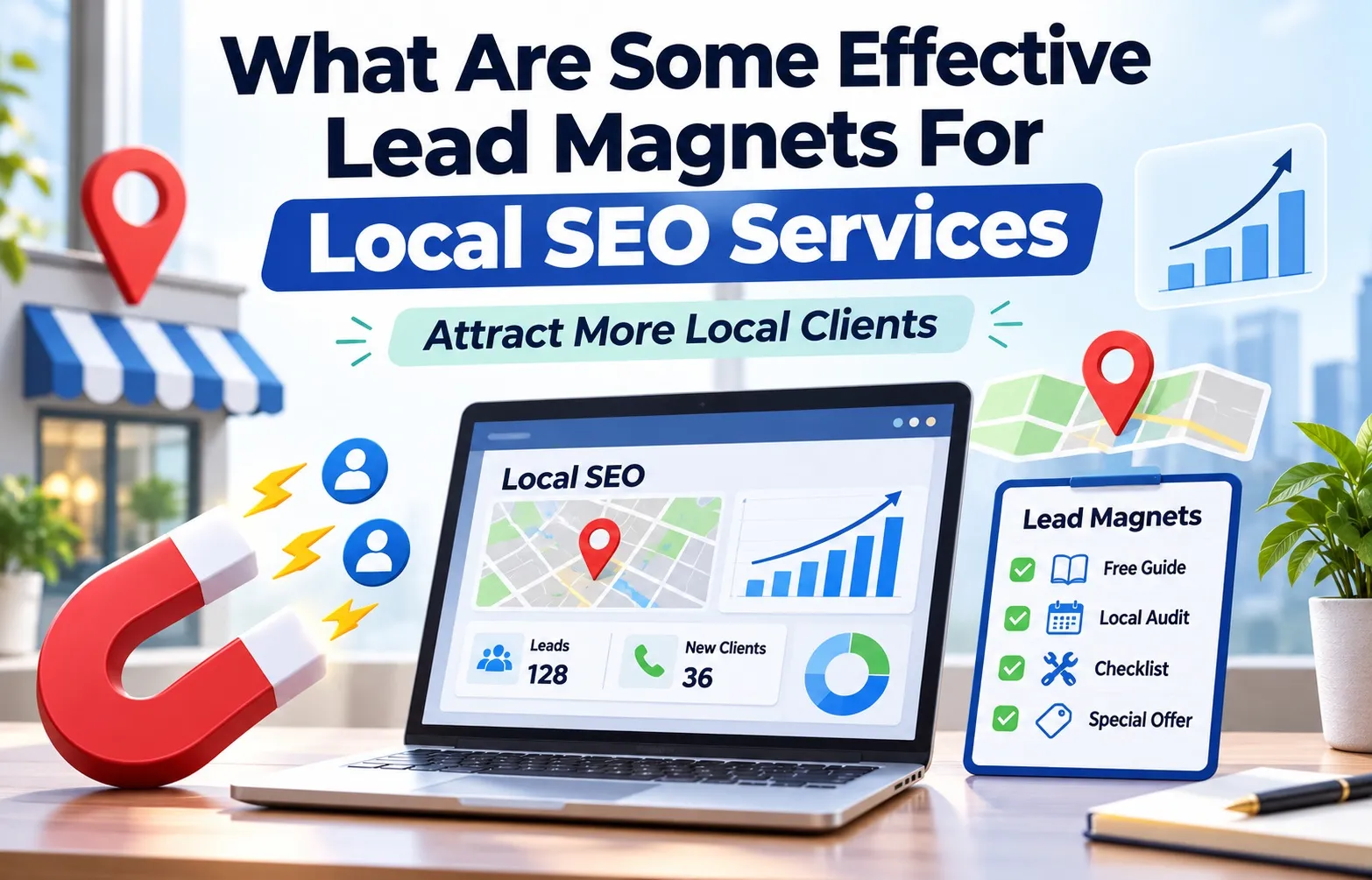
Effective lead magnet ideas for local marketing give business owners immediate, low-risk proof of their visibility gaps. The best options include visual local heatmap audits, automated Google Business Profile teardown reports, interactive self-assessment scorecards, and ready-to-use review request templates.
- Visual map grid scans displaying exact neighborhood ranking performance.
- Automated diagnostic reports checking profile completeness and review velocity.
- Swipe files containing post-service SMS and email review collection scripts.
How to generate leads for SEO services?
To generate leads for SEO services, agencies must combine targeted local landing pages with high-value diagnostic assets. Offering free automated audits captures prospect interest, while streamlined discovery call schedulers turn warm visitors into booked consultation appointments.
- Deploy geo-targeted landing pages optimized for specific service-area search terms.
- Offer instant self-service audit tools that capture contact information securely.
- Automate email follow-up sequences to nurture prospective clients with valuable insights.
What are good lead magnets for service businesses?
Good lead magnets for service businesses focus on quick-win solutions that solve immediate operational headaches. Tools like map visibility scoreboards, local citation clean-up cheat sheets, and post-service review request scripts convert casual website visitors into engaged prospects.
- Quick-win checklists covering local directory citation consistency.
- Map visibility scorecards highlighting real-time local search performance.
- Ready-to-use communication templates designed to streamline customer feedback collection.
What is the best thing to do for local SEO?
The best thing to do for local SEO is to optimize your Google Business Profile and maintain strict citation consistency across major directories. Essential local SEO best practices require accurate business data, precise category selection, and consistent customer review generation.
- Claim and verify your Google Business Profile with accurate primary categories.
- Ensure Name, Address, and Phone data matches identically across all local citations.
- Build a steady, ongoing stream of authentic customer reviews from real service calls.